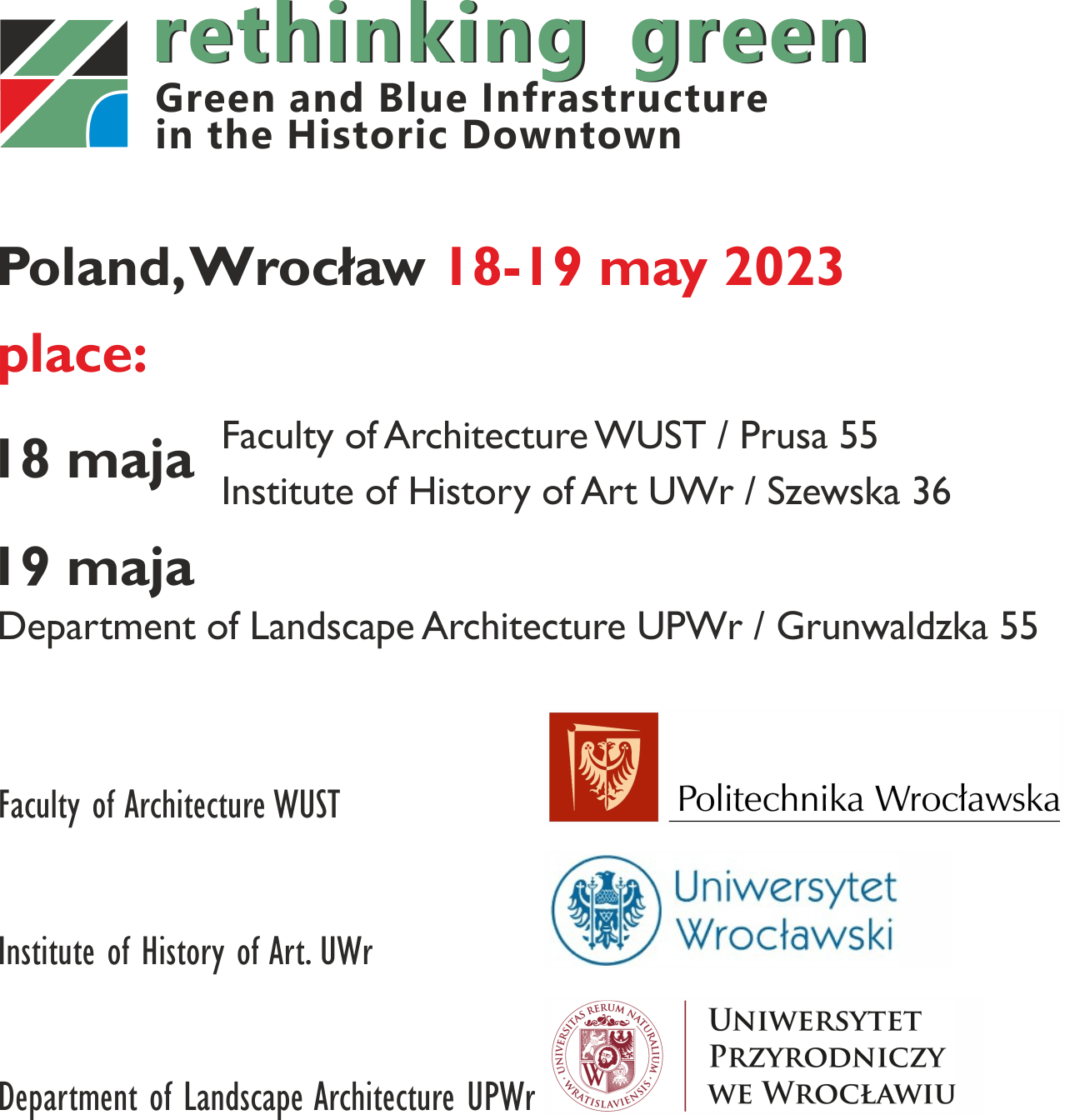
Currently the protection and improvement of the quality of natural environment in the cities are of interest to central and local authorities, activists and associations, as well as experts, scientists and city inhabitants. However, the mentioned above conditions are often in conflict with other, equally important expectations, such as: the protection of the historic old town and downtown density and landscape, which are key elements of the functioning of the tourism industry in the cities; inhabitants’ expectations related to the convenient use of urban infrastructure and access to public and private transport as well as optimal economical expansion of undeveloped areas.
The conference aims to confront the opinions of representatives of various scientific disciplines and professional groups about the situation of greenery and water in intensively built-up historical urban areas. Medieval old town districts as well as city centers erected as a result of urbanization processes in the 19th and early 20th centuries should be taken into consideration. A topic of historical urban areas with a non-residential function (for example unused post-industrial areas), where the natural expansion of greenery becomes a threat to their cultural heritage, is recommended to be discussed as well.

The following particular issues should be taken in the account:
Diagnosis of current problems and forecast of trends
• greenery in downtown development – contemporary challenges and forecasts of changes
• greenery in historic city centers in the context of environmental and ecological issues;
• GBI in the areas of city squares, streets and in the interiors of building quarters in old town districts and downtowns in the historical context;
• culture and nature in areas of dense historical residential development – conflict or symbiosis?
• contemporary design – a threat or an opportunity for historic greenery?
• the role of greenery in city centers in the face of climate change, development of vehicular transport and functional transformations of buildings;
• the development of GBI vs expectations of inhabitants
Methodological basis of research
• scientific premises as a basis for activities in the field of development of GBI in historic city centers;
• methods, techniques and tools in research on the greenery in historic downtown areas;
• how to conduct the pre-project studies for the purpose of local urban development plans, taking into account greenery in its historical and contemporary aspects?
Models of proceedings in field of GBI
• relations between monuments of architecture and urban design and the green and blue infrastructure;
• the requirements of local historical preservation and the expectations of inhabitants, the policy of local authorities and visions of designers – seeking a compromise;
• GBI solutions for the old-town and downtown districts – recommendations;
Case studies and realizations
• problem analysis of selected realizations

dr Iwona Bińkowska, UWr/UPWr
dr hab. inż. arch. Alina Drapella-Hermansdorfer, prof. PWr
dr hab. Rafał Eysymontt, prof. UWr
dr Makary Górzyński, Akademia Kaliska
dr inż. arch. Artur Kwaśniewski, PWr
dr hab. inż. arch. Irena Niedźwiecka-Filipiak, prof. UPWr
dr inż. arch. Justyna Rubaszek, UPWr
dr Agnieszka Seidel-Grzesińska, UWr
dr Elżbieta Szopińska, UPWr
dr hab. inż. Katarzyna Tokarczyk-Dorociak, UPWr
dr hab. inż. arch. Jacek Wiszniowski, prof. PWr
dr Małgorzata Wyrzykowska, UWr
prof. dr hab. Agnieszka Zabłocka-Kos, UWr

Organizational Committee
dr inż. arch. krajobrazu Aleksandra Gierko, PWr
dr Agnieszka Seidel-Grzesińska, UWr
dr inż. arch. Justyna Rubaszek, UPWr
dr hab. inż. arch. Jacek Wiszniowski, prof. PWr
Conference’s languages
Polish, English
Conference’s speech
• research paper (20 minutes)
• case study (10 minutes)
The organizers offer the possibility of publishing conference papers in the journals: Quart, Architectus and Sustainability (MDPI), after meeting the standard requirements of individual periodicals.
Schedule
6th March 2023 – deadline for applications
10th March 2023 –information about the acceptance of the paper in the conference program
17th March 2023 –deadline for conference fee
The conference account number will be provided later.
Registration fee
• participant with paper, participant without paper – PLN 350 (stationary)
• participant with paper, participant without paper – PLN 250 (online)
• free spectator – free of charge
Contributions are welcome from all relevant communities of research and practice, including but not limited to:
• the scientists and researchers, among them: architects, landscape architects, urban developers, urban and architectural theorists and historians, conservation specialists, art historians and historians, sociologists, climatologists and botanists;
• local government authorities and institutions for the protection and study of cultural and natural heritage;
• professional associations, social organizations, and informal groups focused on protection of urban space values;
• practicing architects and designers.
Submissions of applications
In the submissions, please provide:
• full name,
• full affiliation,
• title of the paper,
• abstract (maximum 2000 characters with spaces)
• e-mail address.
Please send the submission to the address: re-green@pwr.edu.pl
Due to time constraints the Conference Committee reserves the right to make a selection of the received applications. Thank you for understanding.
Conference office
Institute of Art History
The University of Wrocław
tel. + 48 71 3752 510 (the Institute office)
Contact addresses:
• re-green@pwr.edu.pl
• conference.regreen@gmail.com
• agnieszka.seidel-grzesinska@uwr.edu.pl
Application form